
The Wall
Illustration as non-verbal communication and the art of self-sabotage

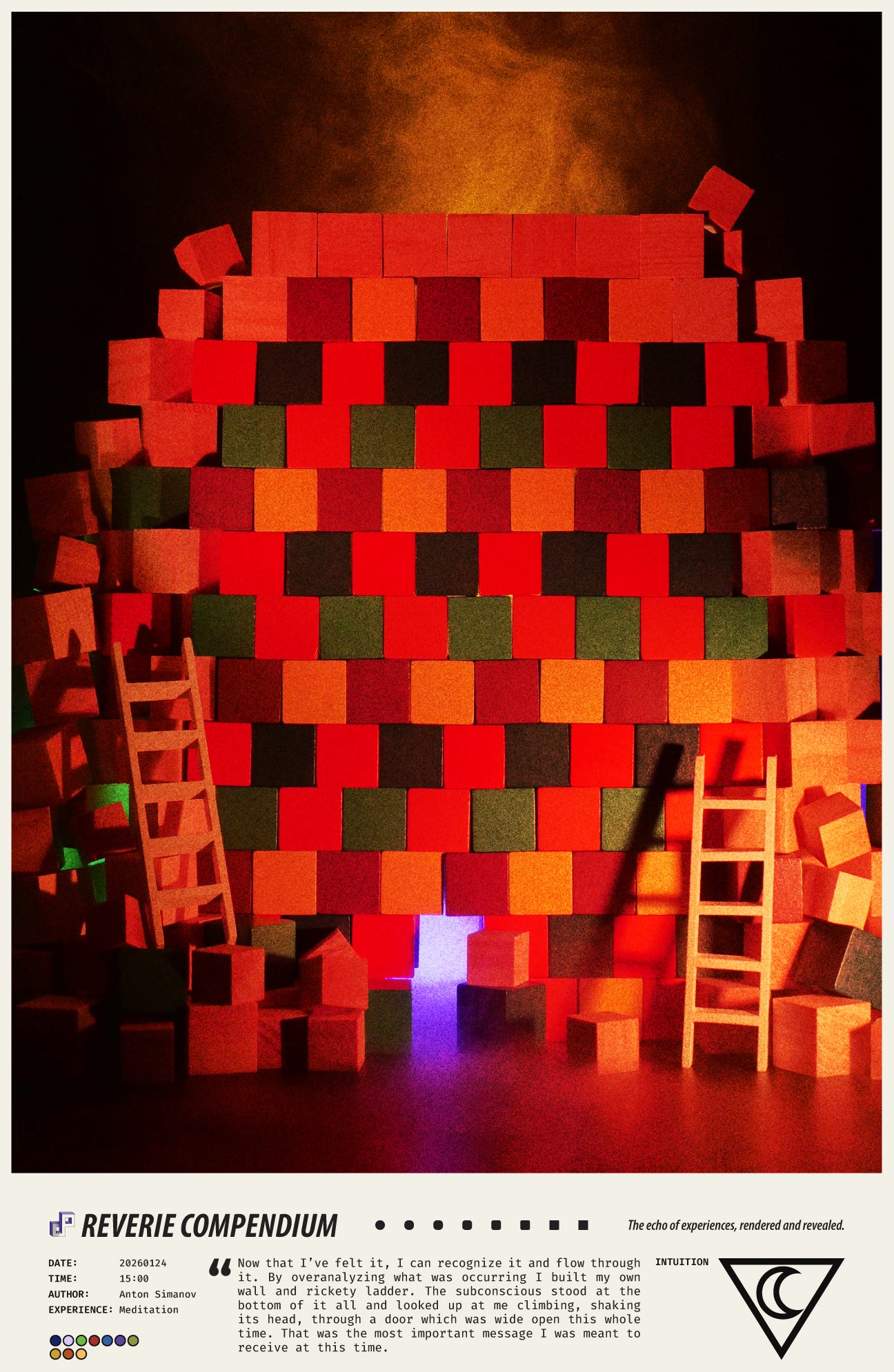
Now that I’ve felt it, I can recognize it and flow through it. By overanalyzing what was occurring, I built my own wall and rickety ladder. The subconscious stood at the bottom of it all and looked up at me climbing, shaking its head, through a door which was wide open this whole time. That was the most important message I was meant to receive at this time.

The Wall
Indeed, this was the important message that I needed to receive right now. Like most people, I have no problem conceptualizing, analyzing, overanalyzing, and at the end of the day being absolutely blind to it all. The deep knowing of what is right or what to do often gets coopted by the ego, which does not know nor understand anything regarding the non-physical and things adjacent to it. Yet, it inserts itself and slips right in when you lower your guard just enough.
From that moment on, which is always very difficult to pinpoint yourself, the “great work” to understand what you’re doing begins. What’s worse is that you’ll inadvertently run the risk of convincing yourself that perhaps, maybe, quite possibly you don’t actually know the thing you’re thinking about. So helpful!
For me, this process often feels like I’m building a wall between myself and what I know. I build the wall with colorful blocks that represent ideas, frameworks, thoughts, thought forms, limiting beliefs, etc., all disguised as necessary structures for my own good. I then place ladders at different locations of the wall and go to work climbing over it.
Completely unnecessary, completely self-sabotaging, and absolutely a self-generating illusion spurred on and engineered by the ego.
Break down the wall (it’s not hard as you’ll notice in the next section), keep the ego small. There’s no room for self-indulgent games that only produce doubt and uncertainty.
Process Documentation
The new workflow continues to evolve and shift. In my previous illustration, I used a praying skeleton figurine as the subject and photographed it in order to get just the right angle and lighting that I wanted. I then took that photo and turned it into a vector. I did this a couple times to simplify and create the form I envisioned from the start. Then I dropped the result into my already established vector-format illustration to add foreground, background, elements, lighting, and photo-grain texture.

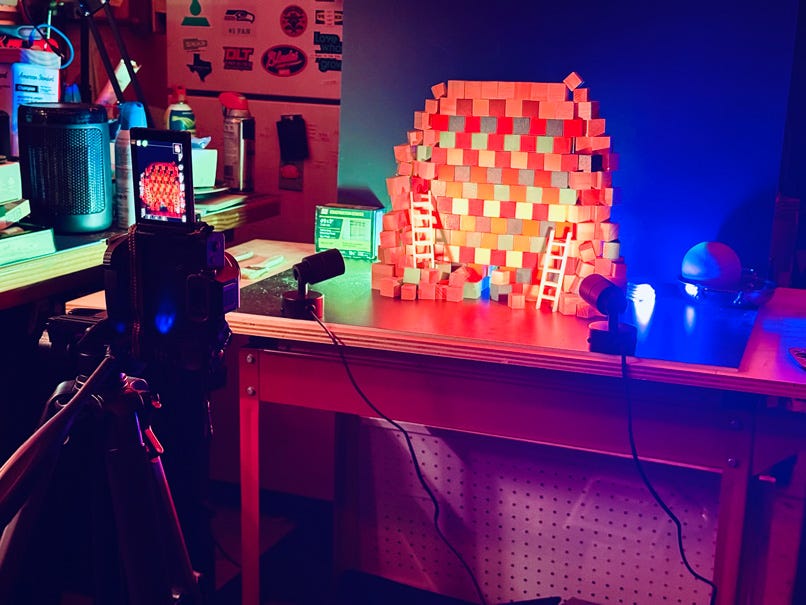
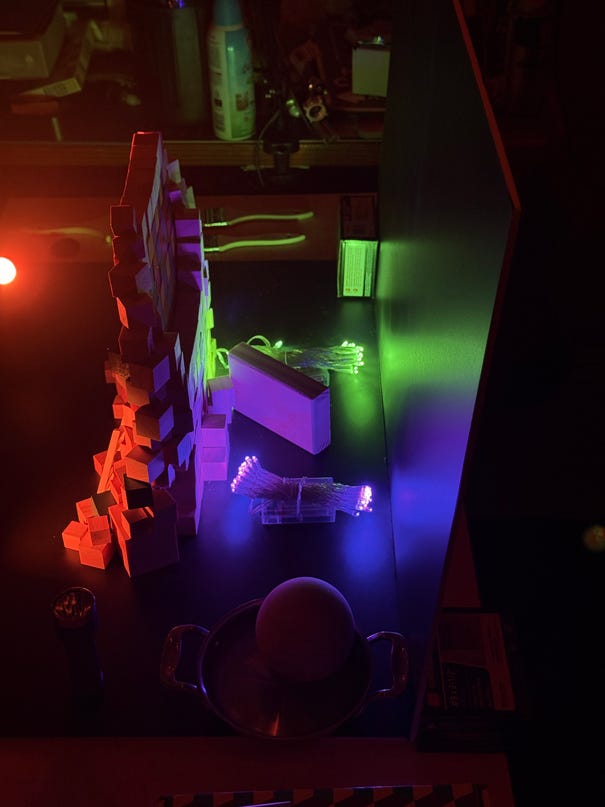
For this piece, the prep or rather the subject-creation took on another aspect. I decided to throw together a makeshift shadowbox rig out of one of my shop’s metal carts, foam core boards, and LED lights (including a Hank Light, also known as Emisar). For the main composition, I used 1” wood blocks, natural and colored. I also had a few varying sized blocks around and a couple tiny ladders for tiny people.
The hastily slapped together rig really isn’t anything to write home about, but I figured a few shots for documentation purposes never hurt anyone.
Enjoy, or don’t. Both are happening.
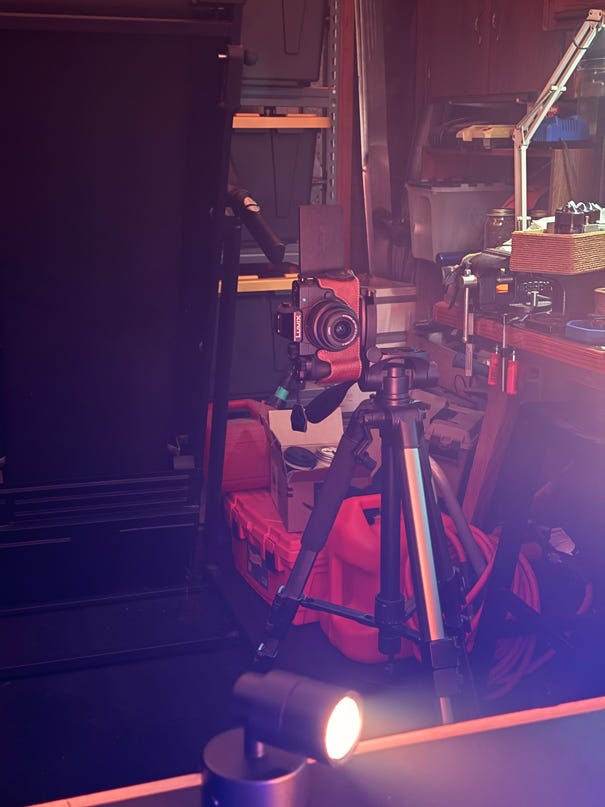
It’s a very handsome camera.
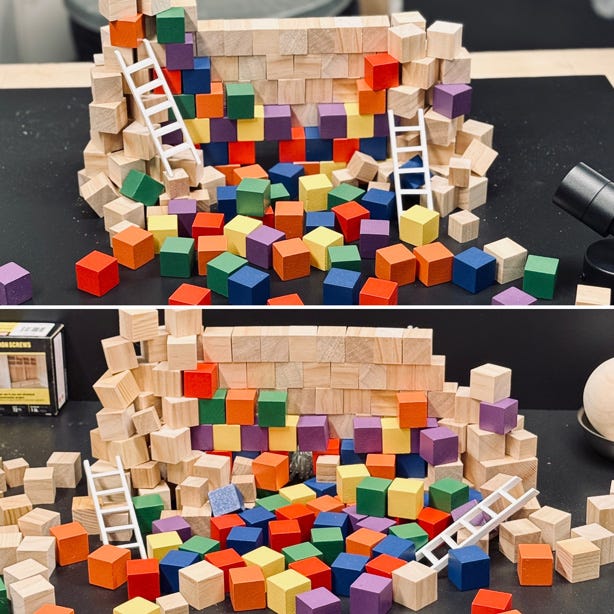
Had to rebuild it at least twice.
Parting Thought
The very last thing I wanted to touch on is, how do you define “illustration”? For the longest time, honestly my whole life up to this year, I have considered an illustration to be strictly a type of descriptive noun. A materialistic view without a doubt. At the end of the day, an illustration’s habitat is predominantly 2D.
A sketch, a drawing, a painting, pixel, vector, 3D model, a mural, graffiti. All adorn a flat, two-dimensional surface. I played with blocks and lights, then took a photo of it with my hipster camera, then I modified, adjusted, and worked over it. All on a two-dimensional medium.
An illustration is non-verbal communication, not the language itself.